Michelle

  • 8 Steps You Need to Know to Write Captivating Blog Posts

    Writing captivating content for your audience is a great way to turn visitors into dedicated readers. In this post, you’ll learn the 8 steps you need to know to write captivating blog posts.

    Writing a blog post takes more than just a couple of hours, even if you can type quickly and have amazing writing skills. From the time you think of a blog post idea until the time you hit “publish” you’ll be planning and writing the actual post.

    You want visitors to turn into regular subscribers.

    You want visitors to get to the end of your post excited to read more of what you have to offer.

    In order for visitors to keep coming back, you have to write captivating blog posts that they will want to read.

    How do you do that? Keep reading and I’ll show you.
    8 Steps you need to know to write captivating blog posts

    How to Write Attention-grabbing Content

    Before you start writing captivating blog posts, you have to know your audience. You need to know what they are looking for and what problems they have that you can solve for them.

    How do you know what your audience wants? Ask them! Send an email asking for their feedback or give them the option to ask questions that you can answer in a full-length post. Send surveys asking them what they are struggling with.

    Other ways to know what your audience wants are:

    • Pay attention to their comments on your other posts as well as posts of other sites in your niche.
    • Use tools like KeywordTool.io to find popular topics people are searching for.
    • Read reviews of books in your niche on Amazon.

    And if you need some ideas for posts, be sure to check out these 180 blog post ideas for any niche.

    8 Steps to Write Captivating Blog Posts

    Step 1: Plan

    Many bloggers overlook the planning stage, which is really important, especially if you are serious about making money with your blog. Planning blog posts ahead will actually save you time later on.

    Here’s what you need to do during the planning stage before you start writing captivating blog posts.

    • Choose a topic: The topic you choose to write about should be interesting to you. If you’re not interested in what you’re writing about, your audience isn’t going to be interested in reading it. Readers can tell when writers are not enthusiastic about their topic. They’ll pick up on the boredom and leave, maybe to never come back.
    • Write an outline: Outlines are very important when it comes to planning your blog. They don’t have to be detailed or super long, either. It just needs to be a guide to make sure you stick to the topic.
      • An example of an outline should be something like this:
        • Title of Post
        • Introduction (quick summary of what the post will be about)
        • Sections and subsections
        • Conclusion
    • Do your research: I don’t mean copy Wikipedia for every topic you cover on your blog. In fact, only using one source for your research is a bad idea. Make sure you’re choosing the right sources and don’t forget to cite them.

    Step 2: Create a persuasive headline

    The headline is the title of your post and should grab your readers’ attention. It needs to make your audience want to read more and share your work with others.

    Headlines sell the content as well as represent it in social media, emails, and search engines. You want to make sure your title tells exactly what your content is about.

    Don’t try to trick readers into reading your content by using a title that has nothing to do with what you are writing about. This will make them see you as untrustworthy and they will never return to your site.

    If you want visitors to read your blog post, then your headline must answer the question they’ve been needing to be answered for a long time. Let’s say you are a food blogger and your readers want to know about baking measurements. You wouldn’t want your post headline to read:

    “Baking Measurements”

    Instead, you would want something more eye-catching:

    “How to Properly Measure Ingredients When Baking”

    Which one would you click on to read?

    Here are two free headline analyzer tools for you to try:

    Step 3: Write an eye-catching introduction

    The introduction is where you will show your readers that you understand what they are going through. You want to make them feel as though you are reading their minds.

    How do you do this?

    With empathy.

    More than likely you’ve struggled with the very issue that you are writing about. Step into your readers’ shoes write from their prospective. Prove to them that you “get it” and you’re on their side.

    Another tip when writing your introduction is to trigger your audience’s emotions. Think of the feelings you want your readers to experience: joy, sadness, hope, anger, courage, and so on. As you write, feel those emotions yourself and your readers will read them feeling the emotions you desire them to feel.

    Step 4: Write easy-to-read content

    People are skimmers so they need something quick and easy to read. To make your post easy for people to read yet still make them see the main points, use subheadings. Subheadings guide readers to the point your post is trying to make in a clear and enjoyable way.

    Subheadings should stick to your main headline and not get off track. Otherwise, the reader will get confused and leave.

    Another helpful tip to making reading easier is to use bullet points. Bullet points highlight your most important information and are easy to skim through. Keep bullet points to 1 or 2 lines, don’t write paragraphs in them. They’re not sentences, just mini-headlines.

    Step 5: Add images to your post to improve flow

    Visual content is processed faster by the human brain than text. Images tell a story just as much as the words themselves. The internet is becoming more and more about visual content than reading.

    Images are also great for sharing to Pinterest and social media. They also help people “see” what you are writing about, especially if you are writing tutorial posts.

    But don’t go overboard! Too many images may make your site take longer to load, causing visitors to leave.

    There are a lot of free sites out there where you can get high-quality images for your posts. Some I like to use are:

    Step 6: Add a call-to-action

    A good and clear call-to-action is something that stands out and asks your readers to engage with you and take certain action after reading your content. You can use a well-designed button or just simple text.

    Some examples of good call-to-action are asking readers to:

    • leave a comment
    • share your post
    • sign up for your email list
    • purchase your product
    • follow you on social media

    Step 7: Close with a conclusion

    Wrap up your post with a short summary of all that you covered.

    Do not add any new information here. That’s for a whole new blog post.

    Step 8: Edit your post

    Step away from your post for a little while, possibly a day or so. This way you can come back to it with fresh eyes and see what can be done to improve the post.

    Keep these tips in mind when editing your post:

    • Remove all unnecessary words, sentences, paragraphs, etc. The only thing your post needs is what is absolutely necessary to get your point across.
    • Don’t lecture your audience, motivate them. Your readers need to feel that you are on their side, not that you are a condescending know-it-all.
    • Add emotion and energy to your writing. If you are bored with your topic, readers will be, too.
    • Make sure your content is easy to read and flows well.
    • Check to make sure you aren’t contradicting or repeating yourself.
    • Don’t jump back and forth within your writing. Make sure your writing is driving the post forward so it reaches its destination smoothly.
    • Make sure sentences are paragraphs flow effortlessly into the next. A sentence should depend on the ones before it, so your writing will feel less choppy and be easier to understand.
    • Use bold and italics to highlight very important words and sentences, but don’t overdo it.
    • Use bullet points to group related topics together and make them easier to read.
    • Avoid words like “might”, “possibly”, “perhaps”, and “may” when giving advice.
    • Add relevant images, infographics, and screenshots to your content.
    • Make sure you are being consistent throughout your post. Make sure all points in a list belong to the same category and a list of steps is only a list of steps.
    • Fix any typos, spelling mistakes, and/or grammar mistakes. Grammarly is very helpful at picking these out for you.
    • Don’t forget to cite any sources you used and give credit where it is due. Honesty is always the best policy.
    • Read your post out loud to help you catch any run-on sentences and choppy rhythm.

    To Recap

    Writing captivating blog posts for your audience doesn’t have to be hard or take weeks. An amazing blog post that stands out to your readers will take more time to write.

    If you follow the 8 steps above every time you sit down to write it will quickly become a habit. And you will have an amazing blog that everyone will be excited to keep coming back to.

    You’ll drive more traffic to your blog and people will want to share your content with others.


    Do you know all the important pages your blog should have? If not, click here to find out!


    pin me
    8 Steps You Need to Know to Write Captivating Blog Posts
  • The Difference Between Categories and Tags in WordPress

    Learn the difference between categories and tags in WordPress with these definitions and examples.

    Whether you are starting a WordPress blog or have been blogging for a while, categories and tags can be confusing.

    While both can be used to organize your site’s content by topic, there are some major differences between categories and tags.

    In this article, I’ll cover the difference between categories and tags, an explanation of each, and how to create them.

    difference between categories and tags

    Related: Blog Posts and Pages: What’s the Difference?

    The Difference Between Categories and Tags in WordPress

    What are categories?

    Categories are used to group the primary topics together & help your readers understand what your site is really about. They are meant to group your blog posts by general topics. They are kind of like the table of contents of your site.

    WordPress posts are required to have one category. If a category is not assigned to a post, it will go under “uncategorized”.

    Categories are hierarchical, meaning you can have subcategories under each parent category. For example, let’s say your blog’s main topic is Household Tips and Hacks. The main category could be “House and Home” with subcategories such as “cleaning tips”, “organizing tips”, and “home hacks”. This helps organize your site so readers can find what they’re looking for easily.

    How to create categories

    1. In the WordPress dashboard, under Posts, click on Categories.
    2. Fill in all the information for the new category – name, slug, and a description of the category. Then click “add new category“. This is called a “parent category.”

    Let’s use the Household Tips blog as an example.

    • Category name: House and Home
    • Slug: house-and-home
    • Description: Tips and hacks to keep your home clean and organized.

    How to create subcategories

    To create a subcategory, you are going to do the same thing you did to create a category. Only this time you’re going to choose a “parent category“. (For example, “House and Home”.) Then click “add new category“.

    If you have already written a post and want to change the category, simply go to Posts > All Posts and select the post want to change. Choose the correct category and click Save.

    Tips on using categories

    • Start with a few general categories and create more as your blog grows.
    • Be consistent: categories are meant to organize your posts so you don’t want a ton of categories.
    • If you are a new blogger, write down the topics you want to cover on your blog, then group like ones together with categories.
    • Include a description of the category. While not necessary, they are helpful for your readers to understand what the category is about.
    • Capitalize categories names.

    What are tags?

    Tags are more for describing specific details of your posts. These are more like your site’s index words. They lead readers to similar posts and help visitors find related content easily.

    Unlike categories, tags are not automatically assigned nor are they hierarchical. Tags are optional, but they are recommended to help readers find similar content on your blog. When a reader clicks on a tag, the will be taken to the archive page where all the posts with that tag are stored.

    How to create tags

    1. To add tags before writing posts, go to Dashboard > Posts > Tags. Add a new tag name, the slug, and a short description.
    2. To add new tags while writing new posts, add the tags to the tag section on the right side of your screen. All you have to do here is right in the tags you want to use. Keep in mind you want similar posts to have the same tags.

    For example, if you are writing a post for a book review, tags could be something like “fiction”, “mystery”, or whatever fits the post.

    Tips on using tags

    • Use tags liberally – a tag can just describe one section of the post, not a summary of the entire thing.
    • Use the same tags for multiple posts.
    • Have fun with them – you can use longer phrases for tags just as long as they link similar posts together.
    • Use descriptive tags – Use clear tags that are easy to understand. Think about how search engines will understand them.
    • Use lower case letters – not required, but common practice and helps readers determine the difference between categories and tags.

    To recap:

    The differences between categories and tags are:

    • Categories are required, tags are not
    • Categories are hierarchical, tags are not
    • Categories are used to link main topics together while tags are used to link similar posts together
    • Category names should be capitalized, tag names should be lower case
    information on categories and tags

    You might like to read these next:
    180 Bog Post Ideas for Any Niche
    Branding Your Blog: A Step-by-Step Guide
    Important Pages Every Blog Should Have


    pin me
    Difference Between Categories and Tags in WordPress

  • Blog Posts and Pages: What’s the Difference?

    When you are starting a blog in WordPress, the difference between posts and pages can be confusing. In today’s post, I’m going to explain exactly what posts and pages are and when and how you should use them.

    When you start a blog with WordPress, you will see two ways to create content – posts and pages.

    At first, it can be a bit confusing to know when and how you should use each one. When I first started blogging, I had the hardest time keeping these two separated and knowing which one did what.

    It’s important to understand the difference between blog posts and pages in order to make your site more user-friendly.

    Keep reading to learn exactly what blog posts and pages are, when you should use them, and exactly how to use them.

    blog posts and pages

    Related: The Difference Between Categories and Tags in WordPress

    What are blog posts and pages?

    What is a blog post?

    Blog posts are where you share your articles for your readers or your latest updates. They are shown in reverse-chronological order, meaning the most recent post will be shown at the top of the page.

    What is a blog post made up of?

    Blog posts are made up of several different things:

    • Post title: A great title catches the reader’s attention so they’ll want to read your content.
    • Date published: All blog posts show the date the content was published, usually appearing at the top of the post.
    • Written by: This is the author who wrote the blog post.
    • Content: Content is where you write the article you want to share with your readers.
    • Comments: The comments section allows your readers to respond to your content. This is a great way to interact with your readers and get to know them better.
    • Categories: Categories are how you organize your blog posts so readers can find what they’re looking for easily.
    • Tags: Tags help readers locate similar content on your blog.

    What is a blog page?

    Blog pages are used to share important information, such as legal information. Pages are more permanent and do not require frequent updating.

    What is a blog page made up of?

    Blog pages are only made up of two things:

    • Page title: The page title lets your readers know what your page is about.
    • Content: This is where you write the important information you want to share on your page.

    The Main Difference Between Blog Posts and Pages

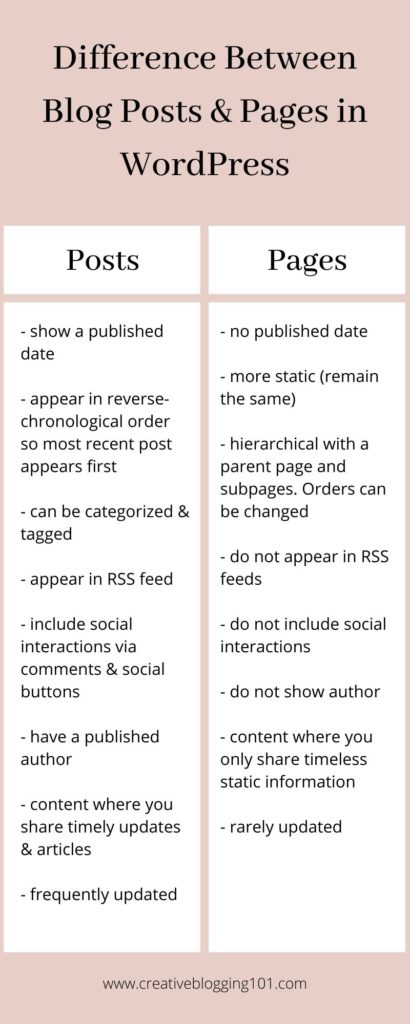
    Blog posts in WordPress are shown by date on your blog site. They have an official publish date attached to them.

    Posts are listed in reverse-chronological order, meaning the most recent post is shown first to readers visiting your site.

    Blog pages in WordPress are meant to be timeless and have no publish date. They are more permanent and do not require updates often. Some examples of blog pages are an “about” page and a “privacy” page.

    Pages are content that visitors to your blog should always see no matter when they visit. They should be placed somewhere on your site where they can be seen, such as your menu, sidebar, or footer.

    Related: Important Pages Every Blog Should Have

    To recap:

    • Blog posts have a publish date and are for normal blog posts and updates.
    • Blog pages do not have a publish date and are for timeless static content.

    Other Differences Between Blog Posts and Pages

    1. Posts can be categorized, pages are hierarchical

    Blog posts have the option to be put in a category and have tags assigned to them. You can find these options on the right side of the screen beside where you write your blog posts.

    Blog pages do not have categories or tag options. Pages are organized hierarchically, meaning you can have subpages, or “child pages” within a page. This is to help you organize your pages together.

    2. Posts are social, pages are not

    Posts include social sharing buttons and a comments section. They are meant for your audience to interact with you and share your content.

    Pages do not include social sharing buttons or a comment section. You probably don’t want visitors to share your privacy page or comment on your contact page.

    3. Posts have a published author, pages do not

    Blog posts in WordPress usually have the author who wrote the content shown at the top of the post. This is usually found next to the published date, depending on your theme.

    Blog pages do not list an author.

    4. Posts are included in RSS feed, pages are not

    Posts will show up in your RSS feed, which allows your audience to subscribe to your content using an RSS reader.

    Pages do not show up in RSS feed. Only your blog’s latest posts will be seen in an RSS reader.

    I hope you now have a better understanding of the differences between blog posts and pages. It’s really important to know the differences so your site will be easy to read and readers can find what they are looking for. You want your site to be user-friendly because if it’s too hard to navigate, visitors will only visit once.

    infographic
    pin me
    blog posts and pages
  • 180 Blog Post Ideas for Any Niche

    Do you have writer’s block? Are you having trouble figuring out what to write about in your nice? In this post I’m sharing some great blog post ideas to help you overcome writer’s block.

    Let’s face it – we all get writer’s block at some point. We open our notebooks and stare at the blank page for hours before shutting it, frustrated.

    Maybe you have writer’s block right now and have no idea what to write for your next blog post.

    Well, you’ve come to the right place because listed below are 180 blog post ideas to help you overcome writer’s block.

    I’ve broken the blog post ideas down under specific niches, but you can use these ideas for any niche! Make them your own and get that blog post written today.

    blog post ideas

    Do you need help finding your blog niche? Click here to read all about blog niches.

    Blog Post Ideas for Any Niche

    Food blog

    1. Quick dinner ideas for busy families
    2. Easy after-school snacks
    3. Diet specific recipes (keto, low carb, low sodium, etc.)
    4. Best Instant Pot dinners
    5. No-bake dessert recipes
    6. Dinner ideas for date night
    7. Recipes with 5 ingredients or less
    8. Meatless Monday recipes
    9. Cookbook reviews
    10. Pinterest recipe fails
    11. Must-have kitchen gadgets
    12. Gift basket ideas for new bakers
    13. Growing your own herbs
    14. The best herbs you need for cooking
    15. How to organize your kitchen
    16. Restaurant reviews in your town, city, state, etc.
    17. Tips for food blog photography
    18. Getting your kids involved in the kitchen
    19. Holiday meals roundups (Christmas, Thanksgiving, Easter, etc.)
    20. Best holiday desserts (Christmas, Thanksgiving, Easter, etc.)

    Beauty blog

    21. Skincare for each season (Fall/Winter/Spring/Summer)
    22. Latest beauty trends
    23. Newest beauty products
    24. Best drugstore products
    25. How to choose colors for your skin tone
    26. Hairstyles that compliment your face shape
    27. How to organize your makeup drawer
    28. Best storage containers for makeup
    29. Easy updos for prom
    30. Best hair masks for dry, damaged hair
    31. Makeup product reviews
    32. Hair product reviews
    33. Skin product reviews
    34. Expensive makeup dupes
    35. Top beauty hacks
    36. Skincare routine
    37. Self-care routines
    38. Beauty stocking stuffers
    39. Top 10 drugstore beauty products
    40. Beauty trends to avoid

    Health/Fitness blog

    41. Top foods for reducing inflammation
    42. How to overcome the fear of judgment at the gym
    43. Walking plan to lose weight
    44. Best free fitness apps
    45. Yoga for beginners
    46. Meal tips for weight loss
    47. Habits to overcome when you’re trying to lose weight
    48. How to get motivated for exercise
    49. Best workout gear on Amazon
    50. The most comfortable leggings for working out
    51. Best stretches for runners
    52. Free YouTube workout videos
    53. Training together as a couple
    54. How to create a fitness plan
    55. How to fit in a workout on your lunch break
    56. Quick workouts for stay at home moms
    57. Creating a healthy meal plan
    58. Best playlists for working out
    59. What should you put in your gym bag
    60. Daily heart-healthy activities

    Parenting/Mom blog

    61. What to pack in your hospital bag
    62. Staying healthy during pregnancy
    63. Trendy maternity clothes
    64. How to care for a baby on a budget
    65. Best books for children
    66. Potty training do’s and don’t’s
    67. Family game night ideas
    68. Date night ideas for new parents
    69. Homeschool curriculum for all ages
    70. How to organize the playroom
    71. How to keep everyone sane on road trips with kids
    72. Summer activities with kids
    73. Fun craft ideas for kids
    74. How to bond with your baby
    75. How to bond with your teen
    76. Playdate ideas
    77. Setting boundaries for screen time
    78. Supporting your kids through grief
    79. Best books for preteens going through puberty
    80. How to cope with empty nest syndrome

    Lifestyle/Personal Development blog

    81.. Creating healthy habits at the beginning of the year
    82. Embracing mental health
    83. Creating morning habits for a successful day
    84. How to create a budget and stick to it
    85. How to overcome rejection
    86. 5 ways to be happier during winter
    87. Reduce anxiety and stress naturally
    88. Motivational/Inspirational quotes
    89. 50 date night ideas on a budget
    90. Bullet journal ideas you need to know about
    91. Simplify your life with these 7 productivity hacks
    92. Money-saving tips and tricks
    93. How you paid off your debt
    94. Movie night ideas
    95. Movie reviews
    96. Book reviews
    97. Holiday gift guides
    98. How to say “no” without feeling guilty
    99. How to be a happier person
    100. 10 ways to stick to your to-do lists

    Cleaning/Organizing blog

    101. 10 ways to organize your home quickly
    102. Organizing tips for the bedroom/bathroom/kitchen/living room
    103. How to clean up fast before company
    104. How to make your own natural cleaning supplies
    105. Fragrance hacks you need to try
    106. Top 10 cleaning hacks for the kitchen
    107. How to deep clean the bathroom
    108. Getting rid of that urine smell in the bathroom
    109. Best organizers for your bedroom/bathroom/kitchen/living room
    110. Tips for cleaning and organizing the garage
    111. How to clean and organize your basement
    112. Quick organizing tips for busy moms
    113. Quick cleaning tips for busy moms
    114. How to keep the house clutter-free when you have kids
    115. How to organize just about anything
    116. How to organize a bathroom so you can get ready quickly
    117. Things you shouldn’t keep in your refrigerator
    118. How to organize a pantry on a budget
    119. 10 things in your home that’s making you sick
    120. 5 motivational ways to clean when you just don’t feel like it

    Home Decor blog

    121. Dollar store hacks for small spaces
    122. How to make a small room look bigger
    123. 7 DIY decor ideas you can make on a budget
    124. Frugal home décor hacks
    125. Best color trends of the year
    126. How to add pops of color to your home
    127. 5 indoor plants that look amazing in your home
    128. Holiday decorating ideas
    129. Holiday home decor DIY’s
    130. How to style your living room
    131. 15 home décor ideas for your living room
    132. Home tour
    133. How to live through a home renovation
    134. How to style a shelf or tv stand
    135. Best patio décor ideas
    136. How to create a gallery wall
    137. How to use keepsakes in your modern décor
    138. Latest furniture trends
    139. How to paint furniture
    140. Top trending light fixtures for any home

    Travel blog

    140. Best ways to travel with kids
    141. What to take on vacation
    142. Hotel reviews
    143. Airline reviews
    144. Beginner traveling hacks
    145. Best destinations for couples
    146. Family-friendly destinations
    147. Cruise review
    148. How to plan a family vacation on a budget
    149. How to pack to save space
    150. How to save money while on vacation
    151. Carry-on bag checklist
    152. Best suitcases roundup
    153. Tips for traveling with a baby
    154. Must do road trip ideas
    155. Travel guide for your state
    156. 7 best places to travel this year
    157. Places to avoid while traveling
    158. Top 15 books for travelers to read
    159. What to pack for traveling overseas
    160. How to travel to a foreign country

    Personal Finance blog

    161. Understanding your electric bill
    162. How to conserve heat in the winter
    163. Best energy-saving lightbulbs
    164. Grocery shopping on a budget
    165. How to reduce food waste
    166. 55 ways to save money at home
    167. How to use coupons at any store
    166. Alternatives to eating out
    167. How to get by without using credit cards
    168. 25 ways to make money with side jobs
    169. How to make your own cleaning supplies to save money
    170. Gift ideas to make on a budget
    171. Tips for selling online
    172. How to watch your favorite tv shows without cable tv
    173. 20 ways to entertain for free
    174. Financial books you need to read today
    175. Top money mistakes young people make
    176. Creating a budget and sticking to it
    177. Budget tips for beginners
    178. Personal financial goals for the year/month
    179. Teaching personal finance to teens
    180. Teaching your kids how to save money

    Pro tips for overcoming writer’s block

    *Disclaimer: Affiliate links included. Click here to read more about what that means for you.

    • Keep a running list of ideas
      • Have a notes app on your phone and jot down blog post ideas as you think of them
      • Keep a notebook and pen close by so whenever you think of an idea you can write it down
      • Keep a blog post idea worksheet in your blog binder to write a running list on (You can get a free printable blog post idea worksheet in my free resources page!)
    • Write ideas on Post-It Notes
      • I stock up on Post-It Notes and stick them everywhere! I have them on my blog binder, in my notebook, and sometimes stuck to my computer.
    • Use your ideas as email topics, too
      • For example, if you write a bunch of posts about how to organize different rooms in your home, then send an email to your list titled “How to organize every room in your home”. Include your list of posts to get your readers involved.
    • Just start writing
      • Start writing a post and if it just sucks, then stop. Save it and come back to it later. Sometimes all it takes is a little time and a mood shift to come up with better content.
    • Keep writing
      • The more you write the more the blog post ideas will start flowing into your mind. Give it time and never give up!
    pin me
    blog post ideas
  • Branding Your Blog: A Step-by-Step Guide

    Do you want your blog to stand uniquely stand out from others? Are you ready to bring in lots of traffic to your blog? You need to put some time into branding your blog to make that happen!

    When I first started blogging way back when, I had no idea what branding your blog even meant! I was all over the place with my colors because I just wanted it to be “pretty.” It wasn’t until I realized I wanted to take my blog further that I started researching blog branding.

    After a total blog rebrand I started gaining more traffic to my site. I changed my theme, organized my menu, and stuck with just a few colors. Now I stay consistent with everything so my readers know exactly how to find me easily.

    Overall, I think my readers feel more comfortable coming to my blog and that has helped them gain a trusting relationship with me.

    branding your blog

    What is Blog Branding?

    Blog branding is not just your logo. It’s how people recognize you and your blog and/or business. You want to stand out from others and you need to be remembered. This is why it’s so important to put time into branding your blog.

    For example, say you are scrolling through Pinterest and you see a lot of similar pins from a certain blogger, or business. Their pin colors, styles, and fonts are always similar. After a while when you see that pin style you immediately know who created it. That’s their brand.

    Blog branding is all about your color scheme, the fonts you use, your overall theme, your logo design, and your graphics. And I’m going to show you how to put all of those together so you can start branding your blog today.

    Steps to Branding Your Blog

    *Post contains affiliate links which means I’ll be compensated if you make a purchase. Click here to read more.

    1. Tell your story

    All great brands start with a story. You need to let people know exactly who you are and what you do. Having a clear brand keeps readers on your site longer because they’ll know exactly what to expect from you.

    Ask yourself these questions when considering your story:

    • What is your blog’s focus? (This is your blog’s niche. If you need more information on finding your niche, click here.)
    • Where do you see your blog going in the future?
    • Who are you writing for? Who is your target audience?
    • What problem are you trying to solve for your audience?

    Writing down your blog’s story is so important for creating a vision for your blog’s brand. Consider creating a vision board for your blog. (I’ll talk about that more later.)

    2. Choose your color scheme

    Usually, you’ll choose your color scheme before designing your blog. To help with choosing colors that go together, search Pinterest for “color scheme” or just do a Google search.

    Typically you should choose 2-3 primary colors and 2-5 secondary colors. The primary colors will be used for your logo and all the main elements for your branding. The secondary colors are used for website links and marketing materials.

    You want your color scheme to be memorable and create a positive impression. The colors need to have the power to connect with your audience and draw them in.

    Ask yourself what you want to achieve with these colors. A feeling? The need to reach your targeting audience? Or is it just about getting noticed?

    3. Choose your fonts

    It’s super important that the fonts you choose are easy to read and can be seen on mobile phones. Cursive fonts or fonts that are too small or light in color are difficult to read. This turns readers off and they’re not going to stick around if they can’t read your amazing work.

    Sans-serif fonts are the most pleasing to the eye. Also, be sure to stick with black on a white background for comfortable reading.

    You can get more creative with fonts in your titles and subtitles because these are bigger than the text in your paragraphs. Because they are bigger, they are easier to read. To help with font selection, check out Canva. They have a fonts section that shows you fonts that go well together.

    4. Create your blog’s theme

    WordPress has some very professional pre-designed blog themes, both free and paid. Most of these themes allow you to change colors, fonts, layouts, etc., allowing you to make it your own.

    There are also a lot of really nice paid themes out there. These are so great because all of the work has been done for you – the hardest part is choosing the one that fits you best. One of my favorite themes is the Neira WordPress Theme. I love the sleek design and all the different layouts you can choose from. Check out VolThemes.com for more fun designs.

    5. Create your logo design

    I personally believe having a logo is super important for branding your blog. It sets you apart from others and lets your targeted audience and readers know who you are.

    Your logo goes at the top of your website, in your favicon, on your business cards, and in your email signatures. Logos should include your name, your brand name, or your company initials. It’s also very important to keep your color scheme going with your logo.

    The logo design that you choose needs to be unique and consistent. Use the same logo for everything, don’t mix it up. This will only confuse your readers.

    My best tips for branding your blog

    • Be welcoming. Your color scheme, layout, and menu should feel familiar and comfortable to your readers. Make it easy for them to find what they are looking for.
    • Be consistent. Make sure you are being consistent with your colors, images, tone, graphics, etc. You want your readers to be able to find you easily.
    • Your tone matters. Your brand is characterized by the tone of voice you use when talking to your audience. For example: energetic and bubbly or serious and ambitious.
    • Know your competition. Check out your competition for inspiration, but don’t copy them. What is their logo? Their colors? What is their message and marketing strategy?
    • Know your audience. Knowing who your ideal audience is will really help with branding your blog. When you really consider your audience, you’ll be able to “talk” to them through your brand. They’ll feel comfortable with you and they’ll feel like they really know you. This is the beginning of a trusting relationship, which is also very important for your blog.
    • Create a vision board. Use a poster board or a notebook to create a vision board for how you want your brand to look. Include the color scheme and fonts you wish to use as well as a drawing of your theme layout. Write out your blog’s story and put that on the vision board, too. Add your logo, blog name, and tagline so you can see it all come together.

    To recap, branding your blog is very important if you plan to monetize your blog. It brings in traffic and makes it easier to grow your audience list. Having a consistent brand shows you’re trustworthy and know exactly what you want.

    Having a brand also makes it easier when it comes to creating Pinterest graphics as well as creating emails for your email list.

    pin me
    branding your blog
  • Contact Page: Why You Need It & How-To Create It

    A lot of bloggers think a contact page isn’t necessary. But they’re wrong. Keep reading to find out why you need a contact page and how to create a stunning one for your blog.

    So far we have created some very important pages for our blog including an “About” page, a “Start Here” page, a “Privacy Policy” page, and a “Disclosure” page. Today we’re going to create a contact page.

    So many bloggers think that a contact page isn’t necessary for their blog. However, they are more than likely missing out on potential customers, guest writers, and collaborators.

    Having a contact page is very important no matter what size your blog is. Especially if you want visitors and readers to get in touch with you.

    contact page

    To see all the important pages every blog should have, click here.

    Why do you need a contact page?

    Other than the reasons mentioned above, a contact page:

    • Protects against spam: Putting your email address on your website leaves you open to receive tons of spam emails. Spambots are constantly scanning for the email address tag on websites.
    • Saves time: Form confirmations can be used to send people their next steps, such as a landing page, a video, or just a simple note telling them you’ll get back with them soon.
    • Potential opportunities: A lot of times, if there’s no way to get in touch on your site, people leave and don’t come back. This means you’re missing out on potential guest writers, collaborators, customers, and readers.
    • Gathers reliable information: People don’t always provide you with all the details when they send you an email. However, with a contact form, you can tell them exactly what you need from them. You can require their email, phone number, and more. You can also include a dropdown box so they can choose the topic.

    What should the page have?

    An effective contact page should be a basic page and only include the following:

    • Contact form: Obviously. This is the easiest and safest way for people to get in touch with you.
    • Social media links: If you plan to have people communicate with you through social media, then include your links on this page as well.
    • Photo: While this is not a requirement, having a photo on your contact page will make your blog stand out and look stunning!

    Set expectations for form users

    • No matter what size your blog is, you should let readers know right away that you will not be able to respond immediately. You can include this in your confirmation message, or somewhere on your page. I include a simple statement in my confirmation message that says, “I will respond shortly.”
    • Make it clear which emails you will not respond to. For example, anyone that seems spammy, or anyone that is just being plain rude. You don’t have to respond to every single email.
    • Have visitors check your FAQ’s page before they send you their questions.

    Best Contact Page Tips

    • Double-check for grammatical and spelling errors.
    • Keep it simple. This is the most basic page on your blog. It’s doesn’t need to be filled up with a ton of information.
    • Only require name, email address, and message on the form itself. Some people do not feel comfortable sharing all of their information with you.

    How to create a simple contact form

    There are a lot of different plugins that you can get for free through WordPress for contact forms. The form I use is WPForms Lite. It’s free and easy to use. It’s beginner-friendly and includes drag and drop options. If you need more features you can always upgrade to the paid version.

    For this example, I’ll be using this form so you can see how easy it is.

    Creating a contact form step-by-step

    1. Install the plugin

    The first thing you need to do is to install the WPForms Lite plugin. Go to plugins, then click add new. Search for “WPForms”, click “install now”. Once the plugin has been installed, click “activate”. (Just as an FYI: the picture for the plugin is a bear waving.)

    2. Create the form in WordPress

    Inside your dashboard, click WPForms on the left sidebar, and then click add new.

    You’ll see a page to select a template. Choose the template you want to use. For this example, I’m going to use the “Simple Contact Form”, which just includes the name, email, and message fields. However, you can edit the fields any way you like or even change their order by dragging and dropping them.

    When you’re done, click save.

    3. Setting notifications and confirmations

    Form confirmation is what the person sees after they submit the form. This could be a simple thank you message, or a redirect to a certain page on your website. There’s already a default message set up, which you can change if you wish.

    Form notification is the email you get after a person submits the form. The notifications will go to the admin email that you have set up on your website. If you want to send the notification to a different email, change it in the “send to email address” field.

    4. Add the form to a page

    Create a new page in WordPress and give it a name, such as “Contact Me” or “Contact Us”. In the body of your page, you can include a short and sweet message, then add the form.

    To add the form, simply click the arrow to add a new block, then search for WPForms. Click it to add it to your page, then in the dropdown menu click the form you just created. Then click Publish at the top right of your page and you’re done!

    So, to recap, don’t underestimate the importance of having a contact page on your blog. You will be missing out on potential customers, collaborators, readers, and guest writers without one. There should be a way for visitors to get in touch with you with any questions or suggestions they may have. And you should want to welcome that to build a relationship with your audience.

    pin me
    contact page pin
  • Disclosure Page – Disclosures You Need on Your Site

    If you are running a monetized blog, then you are required by law to have a disclosure page. I’ll cover exactly what that means in this article. And I’ll also share two different templates for you at the end of the post.

    So far we’ve created a “Start Here” page, an “About Me” page, and a “Privacy Policy Page” for our blog. Today we’re going to create a “Disclosure Page” and learn more about what disclosure is exactly.

    Blogging can be a lot of fun and a little bit addicting. You’re in control of what you say and do and there’s no boss to answer to. You are the boss here!

    However, just because you’re deciding what you write about doesn’t mean you don’t have to include all the legal stuff. And if you live in the United States and run a monetized blog, then a disclosure page is an absolute must. It’s a legal requirement you need to stay out of trouble.

    disclosure page

    Click here to read about all the important pages your blog needs.

    Disclosure vs. Disclaimer

    Before we get started on your disclosure page, you may be asking yourself what the difference is between a disclosure and a disclaimer. Here’s the simple version:

    Disclosures provide your readers with all the necessary information regarding a purchase or promotion. It’s giving your audience a head’s up that you will get paid if they make a purchase through your links.

    Disclaimers let your readers know that you are just sharing information and it’s up to them what they do with that information. Basically, it’s a statement denying your responsibility.

    What is a Disclosure Page for Blogs?

    As mentioned above, a disclosure page for blogs is a written statement that lets your readers know about any relationships you have with brands, products, and partners mentioned on your site. It shares that there is a relationship between you and what you are promoting and there is money involved.

    Not only is a disclosure page a legal requirement, it also creates transparency between you and your readers. This builds trust between you and your audience, which is necessary to run a successful blog.

    Why is it required?

    If you plan to monetize your site through ads, affiliate links, email marketing, selling products, or sponsored posts, then you are required to have a disclosure page.

    Disclosures limit your liability on your content, meaning they help you stay legal and out of trouble.

    The FTC (Federal Trade Commission) has established policies that you must follow in order for your blog to remain legal. These policies allow your readers to know and understand that you will be paid for sharing certain information.

    You can read the full report here so you can understand what is required by law. I highly recommend reading it all very closely.

    Types of Content Requiring Disclosures

    Any time you share a product, company, or band that you will be paid for, then you must include a blog disclosure. This can be a simple statement at the top of your page, but it should link to a disclosure page that has more information.

    Here are two examples of when you can add the simple statement to the top of your posts:

    1. Sponsored posts

    Sponsored posts are posts that you are writing for someone else, such as a brand, and getting paid for. For example, a certain brand of soap sends you their product to try and will pay you to write a post about it.

    You are required by law to let readers know that this is a sponsored post. They need to understand that before they click your link to buy the soap for themselves.

    2. Affiliate links

    Affiliate marketing is where a lot of bloggers make money. Adding a link to a product that your readers may purchase requires a disclosure since you will get paid if they buy the product. For example, writing a post about your favorite farmhouse wall décor and adding links to Amazon for readers to purchase.

    Where do you put a disclosure statement?

    When you write a sponsored post or a post with affiliate links, a blog disclosure statement must be placed as close to the link as possible. Your reader has to see the disclosure before clicking the link.

    A link to your disclosure page must be visible on every page. It’s best to add it to a menu or your website’s footer. I include a link to mine in the footer. Also, you need to add a link to your disclosure page in your disclosure statement.

    Sponsored posts

    For sponsored posts, a simple disclosure statement can be added to the top of your post before your blog content. For example: “This is a sponsored post on behalf of (company name). All opinions are my own.”

    If you plan to share your sponsored post to Instagram, Twitter, or Pinterest then you also have to share a disclosure statement there. A simple way of doing this is to use the hashtags #sponsored or #ad or both. This lets readers know that you were paid to write the post before they read it.

    Sharing a sponsored post to Facebook also requires a disclosure statement, but you have to go about it differently. They have policies that you must follow or your post will be removed or they can even shut down your entire account. (This is another reason I do not use Facebook for my blog.)

    To share a sponsored post on Facebook you first have to apply to have branded content on your own page. To do this, you must follow these steps:

    1. Visit the branded content tool page
    2. Select the page you want to use
    3. Click send

    It takes up to 2 business days for them to respond. You can read more about Facebook Branded Content here.

    Affiliate links

    Affiliate links also require a disclosure statement, which should be as close to the link as possible. Just typing “affiliate links” somewhere in your post is not enough. You have to let your readers know that your content has affiliate links and you will be paid if they make a purchase through one or more of your links.

    For example: On my lifestyle blog, I write a short introduction, then a header before my main content. I know my affiliate links will be in that content, so I include a short disclosure statement saying “Posts contain affiliate links. I may be compensated if you make a purchase through one of the links. To learn more about what this means for you, click here.” I include a link to my disclosure page in the word “here”.

    Amazon has its own disclosure statement that you must include somewhere on your site. You can copy this statement and put it directly in your disclosure page, or put it on your site’s sidebar or in the footer. You can read about that here, under #5: Identifying Yourself as an Associate.

    How to Write a Disclosure Page for Your Blog

    Now that we have went over what a disclosure page is, why it is required, and where you should put a disclosure statement, let’s learn how to write one.

    Here are some disclosure page examples that I love.

    Example #1

    “This blog is a personal blog written and edited by me. We accept forms of cash advertising, sponsorship, paid insertions, or other forms of compensation.

    Also, this blog abides by word of mouth marketing standards. We believe in honesty of relationship, opinion, and identity. The compensation received may influence the advertising content, topics, or posts made in this blog. That content, advertising space, or post will be clearly identified as paid or sponsored content.

    The owner of this blog may be compensated to provide opinion on products, services, websites, and various other topics. Even though the owner of this blog receives compensation for our posts or advertisements, we always give our honest opinions, findings, beliefs, or experiences on those topics or products. The views and opinions expressed on this blog are purely the bloggers’ own. Any product claim, statistic, quote or other representation about a product or service should be verified with the manufacturer, provider, or party in question.

    This blog may contain content which might present a conflict of interest. This content will always be identified.”

    Example #2

    This blog accepts forms of cash advertising, sponsorship, paid insertions, or other forms of compensation. Any paid or compensated content will be clearly distinguished as such. All opinions are, and will always be, my own.

    Any product claim, statistic, quote, or other representation about a product or service should be verified with the manufacturer or provider in question.

    Also, this blog also publishes affiliate links. An affiliate link means I may earn a commission if you make a purchase through my link, without any extra cost to you. (Thank you for your support!)

    You can use these as a reference, but please make your disclosure page your own. It should come from you with your writing personality. But it should include all the legal requirements and don’t forget to add in the Amazon statement if you are an Amazon affiliate.

    I don’t make a full separate disclosure page for my blog. I include it at the bottom of my Privacy Page. You can do this, as well, or you can make it a full page. It’s entirely up to you how you do it as long as you do it.

    pin me
    disclosure page
  • Privacy Policy Page – Why You Need One

    A privacy policy page is a must-have for bloggers, so don’t skip this page. In this article, I’ll go over why a privacy page is so important as well as show you how to create one.

    Your blog has been created and you have some posts written. You’re good to go, right?

    Not so fast.

    Every blog needs a privacy policy page in order to comply with state, federal, and global laws. These laws protect consumer privacy rights in every state.

    Refusing to follow these laws can land you some hefty fines.

    But, don’t worry. Creating a privacy policy page for your blog isn’t difficult and can be done fairly easy. I’ll show you how!

    First, let’s go over what the heck this page even is.

    privacy policy page

    To read about all the important pages your blog should have, click here.

    What is a privacy policy page?

    Whenever you visit any website, you are leaving behind pieces of information. This includes your name, email address, IP address, and more.

    The purpose of this page is to disclose:

    • what information the website collects
    • what the website does with collected information
    • who else has access to that information
    • how the information is protected
    • how long the information is kept

    Creating a privacy policy page protects you from legal liability and protects your readers from any potential privacy breaches.

    Since just about every website you visit is collecting privacy information, you need to be protected.

    How blogs collect private information

    Blogs are no different that other websites when it comes to attracting an audience. We all want our audiences to eventually convert to subscribers. To do that, we have to collect their names and email addresses.

    However, that’s not the only way blogs collect private information from readers. The list goes on and on.

    How private information is collected:

    • List sign up forms (so readers can sign up for your email list)
    • Contact forms
    • Chat tools (require email or other personal information)
    • Social sharing tools (anytime a reader shares your blog post)
    • Comment form
    • Ecommerce (for online stores)
    • Cookies (most websites require that you accept the cookies)
    • Third party services (such as ads)

    If your blog has one or more of these items (and most likely it does) then you must have a privacy policy page to comply with the rules.

    How to create a privacy policy page

    To begin with, let’s go over what this page should have and do.

    A privacy policy page should:

    • be well written and easy to understand
    • identify all the possible ways your blog is collecting readers’ personal information
    • include information you collect directly (ex: pop-up forms) and indirectly (ex: ads)
    • acknowledge your respect for and regard to all applicable laws

    My favorite way to create a privacy page is with a privacy policy generator. This is so simple – just fill out some information and the generator does all the hard work for you.

    The generator I use for my page is PrivacyPolicies.com. It’s super simple and the best part is that it’s free to use!

    After filling out all of the required information, you have the option to download it or copy and paste it right into your page.

    They also offer free clauses for analytics tools and ads. If you want anything extra, you will have to pay for it.

    Where to place the page on your blog

    After you’ve created your privacy policy page and published it, you want to make sure it is somewhere that it can be seen. This can include your footer, your sidebar, or in a secondary menu. A link to the page can also be placed in a sub-menu as a drop-down under your “about” section.

    You must familiarize yourself with all the legalities if you are serious about running a successful money-making blog.

    Favorite Resouces

    GDPR – “What is GDPR, the EU’s new data protection law?”

    Privacy Policy Requirements for a Blog

    pin me
    how to write a legal privacy policy page
  • Creating an Amazing About Me Page

    Do you really need an about me page for your blog? We’ll cover that answer and more in this article on creating an amazing about me page.

    You may be asking yourself if an ‘About Me’ page is really important for your blog. Guess what? It is!

    An ‘About Me’ is usually where potential clients go first because they want to learn more about who you are what it is that you do.

    This page is also a great way to promote your brand.

    The con of writing an ‘About Me’ page is that it’s not exactly easy to do. However, if you follow my tips you will be creating an amazing ‘About Me’ page with no problem whatsoever.

    creating an amazing about me page

    Why do you need an ‘about me’ page?

    Believe it or not, your ‘about me’ page isn’t about you at all.

    It’s about the person who clicked on the link to get to the page.

    Consider your ‘about me’ page your interview with your readers. You are working on building a trusting relationship and connecting with your readers. Also, you want them to understand exactly why they need you to help them over anyone else.

    What exactly is an ‘about me’ page?

    Most of the time the ‘about me’ page is the first page a new reader visits. So it’s very important to have a link to this page somewhere you know readers will see it immediately. It’s also usually the most visited page on your site.

    Whenever a new visitor comes to your site they want to learn more about who you are as a person or as a business. They want to hear your personal story as well as how your business came to be. This page is where you will build trusted relationships with your readers and keep them coming back.

    An ‘about me’ page is your chance to connect with your audience and keep them intrigued. You want to convince them you are the person they should be working with. You need to include your bio, your credentials, and your story.

    Creating an amazing about me page step-by-step

    Step 1: Trigger a feeling

    The very first thing you want to do when writing an ‘about me’ page is to grab the reader’s attention immediately. This can be done with a statement that triggers a feeling in the reader.

    Let the reader know that you understand why they visited your site. Ask questions about your business and if the reader answers “yes” to more than one question, they know they are in the right place.

    Example: Are you always to busy to elaborate meals? Are you constantly too tired to cook? Are you eating out more than eating at home? Then you’re in the right place!

    Step 2: Get into their heads

    The second section an ‘about me’ page should allow people to decide whether or not you are the right one for them. Use empathy to get into their heads and make them believe you really understand them.

    Stir up their emotions and really get them on your side.

    Example: “You’ve tried everything to lose weight and nothing is working. You’ve cut out carbs and sugars and it’s still not working. It’s frustrating and depressing. Believe me – I get it! I’ve been there, too!”

    Step 3: Brag through others

    Sure we can brag on ourselves all day, but other people get sick of that eventually. What they want to know is what other people are saying about us.

    What other people are saying about us speaks louder than what we can ever say about ourselves.

    While you are creating an amazing ‘about me’ page for your blog, add a section of testimonials and social proof of others speaking for you. This lets your readers picture themselves as part of your community.

    Example: “What others are saying about me.”

    Step 4: Add your bio

    Once you have proven to your audience that you deeply care about them, tell them more about yourself.

    Make a personal connection with your readers by

    • stating why you do what you do
    • stating your mission
    • using a short story to sum up your background (make it memorable)
    • including a photo or 2 of yourself

    People connect with other people. They want to see faces and learn names.

    Step 5: Ask them to keep in touch

    To make sure your readers are going to stick around, ask them to keep in touch by signing up for your email list. You could offer an incentive to get them even more excited to join, such as a free resource or ebook.

    Include multiple options for readers to sign up for your email list throughout the page. Your first option should go under the second section – after you’ve told them exactly why they need you. The next option should be after your testimonials and social proof and the last option should be at the very end of the page.

    My best tips:

    • When creating an amazing ‘about me’ page you want to use your own writing voice.
    • Don’t be afraid to use a little humor, just don’t overdo it.
    • Make sure you include your name and your credentials.
    • Add a photo to let your readers see what you look like because this builds trust.
    • Don’t drag your story out, get to the point.
    • Remember: your ‘about me’ page isn’t about you at all.
    • Talk to the readers about:
      • why they should be on your site
      • the problems you solve
      • how you can help them
      • what they are interested in

    Grab your FREE checklist here!

    arrow

    creating an amazing about me page checklist
    pin me
    creating an amazing about me page
    creating an amazing about me page

  • How to Write a Start Here Page

    A “Start Here” page, also sometimes called “Begin Here” or “[Your Blog Name] 101”, is a page on a blog that’s designed for new visitors. It’s kind of like a tour guide: it helps them navigate the blog’s content efficiently.

    Here’s what a Start Here page offers:

    • Introduction: A brief overview of the purpose of your blog, the topics you write about, and the value your posts provide to readers.
    • Content Highlights: Includes your blog’s most popular posts, categorized by topic or theme. This lets new visitors find the topics they’re looking for easily.
    • Navigation Guide: Blogs can accumulate a large amount of content over time, so a Start Here page can help readers understand how your blog is organized. It might explain categories, tags, or how to search for specific topics.
    • Call to Action: This could be anything from subscribing to your blog’s email list to following you on social media.

    The goal of a Start Here page is to improve the experience for new visitors by:

    • Reducing bounce rate: Giving visitors a clear direction makes them less likely to get lost and leave the blog altogether.
    • Increasing engagement: Highlighting your best content gets visitors hooked and encourages them to explore further. And possibly sign up for more so they never miss a post.
    • Building a community: A Start Here page can also be a platform to introduce you and your personality, which proves you are a human that readers can relate to.

    Basically, a Start Here page is a valuable tool for bloggers to make a good first impression and turn new visitors into loyal readers.

    how to write a start here page for your blog

    What’s the Difference Between a Home Page and a Start Here Page?

    A home page is meant to catch attention. It let’s visitors know what you do and how you can solve their problems.

    On the other hand, a start here page leads visitors in the right direction and draws attention to your best content.

    How to Write a Start Here Page for Your Blog

    Step 1: Make a memorable first impression.

    The first line of your Start Here page must grab the attention of the reader immediately. Sometimes, readers will only look at this page so you only have a few seconds to grab their attention and keep them reading.

    Create a headline that offers a solution to their problem, such as:

    • “Are you dreaming of working from home and spending more time with your family?”
    • “Have you tried to lose weight but find it impossible?”
    • “Is your home filling up with too much stuff? Let’s unclutter together!”

    Step 2: Create a human connection.

    Be personal and vulnerable. People like reading stories about others that they can relate to. Don’t just share all of your achievements, add in some struggles you’ve encountered, too.

    The idea here is to relate to your ideal reader on a personal level. Think of yourself as talking to a friend.

    Be sure to include a photo of yourself, preferably one of you with a smile.

    • Example: “Hi! I’m ___________ and I really enjoy ______________ but not ____________.”

    Step 3: State who you are helping.

    Be very clear upfront on exactly who your target audience is. If you’re trying to help bloggers learn how to make money, then someone who’s looking for recipes will know they can’t find any on your site.

    Also, be sure to state the purpose behind your blog. Are you writing to educate, inform, entertain, solve a problem?

    This is the step that is answering your reader’s questions: “What’s in it for me? What can you do for me?”

    • Example: “Let’s cut to the chase: this blog is for you if you’re an aspiring blogger anxious to turn your passion into profit. Feeling lost in a sea of information on how to make money blogging? We’ve all been there. That’s why we created this resource – to guide you through the process, step-by-step.”

    Step 4: Explain exactly how you are going to help.

    After focusing on who you are going to help, state exactly how you plan to help them. What can you do for them that others can’t?

    • Example: “I’ve been helping new and established bloggers build and grow a successful money-making website for 5 years.”

    Step 5: Prove it.

    Here is where you get to show off your credibility so you need to share visible proof of your expertise.

    You can do this by sharing testimonials from clients, social proof (followers), blog traffic stats, income reports, academic or corporate background.

    Another great way to prove your credibility is to share logos from big sites that you’ve collaborated with on your page.

    • Example: “See what others are saying!” (Share a few testimonies.)

    Step 6: Convert readers to subscribers.

    Now you’ve made a personal connection with your readers and you have proven you can help them solve their problems.

    By now they are loving you, but chances are they may not remember to come back to your site.

    Include a call to action to get them on your mailing list. You can do this by adding a button that leads to a landing page or an embedded form on your contact page.

    • Example: “Don’t miss out on valuable insights and the latest strategies. Subscribe to my email list for exclusive content, actionable tips, and inspiration delivered straight to your inbox. We offer a hassle-free unsubscribe option, so you’re always in control.”

    Also add your social media links and ask readers to engage with you there. This will make you stand out as well as make you more memorable. And remember to be active on social media!

    • Example: “Want more awesome tips and connect with a supportive community of fellow bloggers? Follow me on social media!”

    Step 7: Show them your best content.

    Make it easy for readers to find what they’re looking for by adding links to your most popular posts. You can also use thumbnail images for visuals.

    • Example: “Readers also love these: (link to posts)!”

    What Should I Put on My Start Here Page?

    When thinking about what to put on your Start Here page, ask yourself these two questions:

    1. What do I want visitors to learn about when they find my website?
    2. How can I let visitors know they are in the right place?

    Make a list of things that answer those two questions. Then ask yourself:

    1. Do these things add value to my audience and to myself?
    2. Can I organize these things to make them flow well together?

    If the answer is “no” to either of these, then you’ve identified something that doesn’t belong on the page.

    Here are some ideas of what to include:

    • Featured opt-in: Make visitors feel welcome by offering them a free gift, such as a mini course, checklist, workbook, or anything else of value.
    • Your most popular posts: Or a list of posts that new visitors would find most helpful while learning about your topic.
    • Categories: Instead of a list of post, consider showing posts from specific categories. This lets visitors decide what they want to dig into first.
    • About section: Your Start Here page is a great way to introduce yourself.
    • Social media links: Make it easy for visitors to find and follow you on social media.
    • Products and services: Keep this short and sweet because first timers aren’t likely to buy from you. They need to know they can trust you first.

    Where Should I Put the Link to My Start Here Page?

    There are four places on your website that are best for placing the link to this important page:

    • In the top navigation bar on the left side: Since people read from left to right (in most languages), left is usually the direction the eyes go to first.
    • In the sidebar
    • A large call-to-action on your homepage
    • Your welcome email

    My best tips:

    • Use shorter paragraphs that contain only 2-3 sentences to make your page easy to scan. Most of the time readers only read the first 2 sentences of a paragraph before moving on.
    • Speak like a knowledgeable friend, not a condescending jerk. You want your readers to like you and find you friendly. This helps them connect with you. If you speak like a know-it-all and talk down to them they may not stick around very long.
    • Tell your story in a relatable way. Use words that trigger certain emotions in your readers to make them feel your story is also their story.

    Key Takeaways:

    • A “Start Here” page acts as a tour guide for new visitors to your blog, helping them navigate your content and understand what you’re all about.
    • This page can significantly improve the user experience by reducing bounce rates, increasing engagement, and fostering a sense of community.
    • To write an effective “Start Here” page, focus on making a strong first impression, showcasing your credibility, and providing clear calls to action for readers to subscribe or explore further.
    • Include elements like an introduction, content highlights, navigation guide, and links to your best content.
    • Remember to prioritize scannable content, a friendly voice, and a relatable story to connect with your audience.
    How to write an effective start here page for your blog

    Find more great blogging tips in these posts:

  • Finding Your Blog Niche

    Stuck staring at a blank blog page? Let me help you with finding your blog niche!

    So you’ve got this awesome blog idea, but picking a specific topic feels like picking a winning lottery number. Don’t worry, figuring out your blog niche isn’t magic. It’s about combining what you love with what people are searching for.

    When I started blogging years ago, I mostly wrote about my life. After a while, I started writing about gardening because that’s what I was learning the most about at that time. I wanted to share my experiences and what I had learned.

    But then I realized that I didn’t really like gardening all that much. My mom has a green thumb and loves her plants, but I am the complete opposite.

    Eventually, I started writing about what interested me the most and what I knew the most about – housekeeping. Finally finding my niche was exciting because it became so much easier to write posts. Plus I had a ton of post topics floating around in my head. My first blog (Blessings by Me) falls under the Lifestyle niche, with sub-niches about cleaning, organizing, home hacks, frugal living, etc.

    So let’s dive in and learn more about niches and finding your blog niche!

    (This post contains affiliate links, which means if you make a purchase through one of my links, I will get a small commission.)

    influencer - finding your blog niche

    What is a Blog Niche?

    A blog niche is your blog’s area of focus, the specific topic you’ll be building your content around. Having a niche allows you to narrow down your targeted audience and write content that answers their questions and solves their problems. The content you write about is relevant only to your targeted audience.

    Finding Your Blog Niche: Why Niche Blogging is the Key to Success

    The key to establishing a successful blog lies in finding your blog niche. A niche isn’t just a trendy buzzword; it’s a strategic decision that focuses your content and builds a loyal subscriber list.

    Here’s how a niche benefits your blog:

    • Targeted Audience: By focusing on a specific topic, you attract readers who are truly interested in your area of expertise. This targeted approach allows you to customize your content to their needs and interests, which builds a deeper connection.
    • Content Clarity: A niche provides a clear direction for your blog, preventing content from becoming scattered or irrelevant. This consistency builds trust and establishes you as a thought leader within your chosen field.
    • Search Engine Optimization (SEO): Search engines favor focused content. A well-defined niche makes it easier for search engines to understand your blog’s purpose, increasing your chances of ranking higher in relevant searches. This, in turn, drives more organic traffic to your site.

    Things to Consider When Choosing Your Blog Niche

    Choosing the right niche is important for building a strong foundation for your blog. When you’re truly passionate about your blog niche, creating content becomes less of a chore and more exciting. No matter what niche you choose, it should be a topic you’re truly interested in. This will keep you motivated to stick with it.

    Here are some things to consider when choosing your blog niche:

    1. Passion and Expertise:

    • Do what you love: This is where the magic starts. Choose a topic you’re genuinely interested in and enjoy learning more about. Your enthusiasm will translate into engaging content and keep you motivated in the long run.
    • Leverage your knowledge: Think about your hobbies, skills, or past experiences. Is there a topic you’re knowledgeable about that you can share with others?

    2. Audience Interest and Profitability:

    • Market research is key: Once you have some niche ideas, see if there’s an actual audience for them. Use online tools like Google Trends or social media to see what people are searching for or what problems they have that need solving.
    • Monetization potential: Consider how you might generate income from your blog. Does your niche offer opportunities for advertising, affiliate marketing, or selling products/services related to your topic?

    Here are some additional factors to keep in mind:

    • Competition: While a little competition is healthy, avoid oversaturated niches. Can you find a sub-niche within a broader topic to stand out?
    • Content longevity: Is your niche a fad, or does it have long-term potential? Choose a topic with lasting appeal to ensure your blog stays relevant.
    • Personal growth: Can you see yourself continuously learning and expanding your knowledge within this niche?

    By carefully considering these factors, you can choose a blog niche that’s both fulfilling and sets you on the path to blogging success.

    finding your blog niche

    Most Profitable Blog Niche Ideas

    When I started my first blog, I had no idea what I was doing. I didn’t know anything about SEO or that I could make money with my blog. I was doing it as a creative outlet. But I started seeing other bloggers talking about how they were making money blogging so I decided to do some research. What I learned was that any blog niche can make money. However, some niches are easier to make money with than others.

    Here’s a list of the top blog niches that tend to be profitable:

    • Health and Wellness: People are constantly searching for information on how to improve their physical and mental well-being. This broad niche offers opportunities for content on fitness, nutrition, weight loss, mental health, and more. You can target a specific audience within this niche, such as vegan recipes, workouts for busy professionals, or meditation techniques for stressed moms. Wellness Mama is a great example.
    • Personal Finance: Financial literacy is a major concern for many people, making personal finance a profitable niche for bloggers. You can offer advice on budgeting, saving, investing, and debt repayment. If you feel that’s too broad of a niche, you can break it down into sub-niches such as real estate investing or cryptocurrency. Make Sense of Cents is a great example of this niche.
    • Technology and Gadgets: Tech enthusiasts are always eager to learn about the latest gadgets, software, and trends. Tech blogs can cover a wide range of topics, from product reviews to software tutorials. You can also niche down to focus on specific areas like artificial intelligence, cybersecurity, or virtual reality. Tech News World is a great example.
    • Food and Cooking: Food is a universal topic that never goes out of style. Food blogs can share recipes, restaurant reviews, or cooking tips. You can target a specific audience by focusing on particular dietary needs or cuisines. A great example is Pinch of Yum.
    • Travel and Adventure: People love to travel and read about new destinations. Travel blogs can share inspiring stories, practical tips, and beautiful photos. You can focus on a specific type of travel, such as budget travel, luxury travel, or solo female travel. Dive Into Malaysia is a great example of this niche.
    • Home Improvement and DIY: Many people enjoy fixing up their homes and doing DIY projects. Home improvement blogs can provide instructions on how to complete specific tasks, plus product reviews and inspiration. You can target a specific area of home improvement, such as gardening, woodworking, or plumbing. I personally love Family Handyman.

    Finding Your Blog Niche: A How-To Guide

    Finding your blog niche involves identifying a specific topic or area of interest that you’re passionate about and that has the potential to attract a dedicated audience. Here’s a step-by-step guide to help you find a niche for your blog:

    1. Identify your passions and interests: Start by making a list of topics that you’re truly interested in and knowledgeable about. Consider your hobbies, experiences, expertise, and what you enjoy discussing or learning about.
    2. Research audience demand: Once you have a list of potential topics, research to see if there’s an audience interested in those topics. Use tools like Google Trends, keyword research tools (such as Google Keyword Planner, SEMrush, or Ahrefs), social media platforms, forums, and communities to gauge interest and demand.
    3. Analyze competition: Look at existing blogs and websites within your chosen topics to understand the competition. Evaluate the quality of content, engagement levels, audience size, and the monetization strategies they use. Assess whether there’s room for your blog to offer something unique or fill a gap in the market.
    4. Narrow down your niche: Refine your topic to make it more specific. For example, if your initial interest is in fitness, you might narrow it down to a specific niche within fitness, such as body weight workouts for beginners or healthy recipes for busy professionals. A narrower niche can help you stand out and attract a more targeted audience.
    5. Consider audience demographics: Think about the demographics of your target audience, including their age, gender, location, interests, and problems they’re looking to solve. Customize your niche to appeal to this specific audience.
    6. Evaluate monetization potential: Consider the potential for monetization within your chosen niche. Explore different monetization options such as affiliate marketing, sponsored content, digital products, online courses, or advertising. Choose a niche where there are viable monetization opportunities.
    7. Assess long-term sustainability: Think about whether your chosen niche has long-term potential. Avoid trends that may quickly fade away unless you’re willing to adapt your content over time. Aim for a niche that allows you to create evergreen content that remains relevant and valuable to your audience over the long term.
    8. Test your niche: Before committing fully to your chosen niche, consider testing it out by creating some initial content and gauging audience response. Monitor engagement metrics, feedback from your audience, and any signs of growth or interest. Keep in mind, though, that this will take a while.
    9. Be flexible and willing to adapt: Remember that your niche may evolve over time based on audience feedback, changes in your interests, or shifts in market demand. Stay open to adjusting your focus as needed to ensure the continued success of your blog.

    What comes after finding your blog niche?

    1. List of 50

    Ready to brainstorm? With your niche identified, it’s time to generate content ideas! Find a quiet space at a library, coffee shop, or even your bedroom. Grab a pen and a piece of paper and start writing ideas for blog posts. Aim for at least 50 blog post ideas, broad or specific.

    For example, if your niche is about home organization for busy moms, your list could include “30-minute cleaning hacks” or “Morning routine organization for a smooth start.”

    Need help coming up with ideas? Here’s a list of 180 blog post ideas for any niche!

    2. Draft sample posts

    Time to write! Choose 5 ideas from your list and start writing. These are drafts, so focus on getting your thoughts down – you can always edit and strengthen them later. Aim to complete these 5 posts within a week or two.

    With this initial batch, you’ll have a solid foundation of content. Consistency is key – strive for one or two posts a week to build a strong presence in your niche. Remember, you can always add more ideas to your list as you go!

    finding your blog niche

    Conclusion: Finding Your Blog Niche

    Congratulations! You’ve taken the important first steps of finding your blog niche. With a focused topic and a passionate drive, you’re well on your way to building a successful blog.

    Here are some key takeaways to keep in mind as you move forward:

    • Content is king: Now that you know your audience, consistently create high-quality content that caters to their needs and interests.
    • Be a thought leader: Establish yourself as an authority in your niche by sharing valuable insights, conducting research, and offering unique perspectives.
    • Embrace community: Engage with your audience, respond to comments, and build a sense of community around your blog.
    • Promote your work: Don’t be afraid to spread the word! Utilize social media, guest blogging, and SEO strategies to reach a wider audience.
    • Enjoy the journey!: Blogging should be a rewarding experience. Let your passion for your niche shine through and have fun with the process!

    Remember, success takes time and dedication. By following these tips and consistently putting out great content, you’ll be well on your way to becoming a successful blogger in your chosen niche.

    Need more? Read these amazing posts next:
    8 Steps You Need to Know to Write Captivating Blog Posts
    Branding Your Blog: A Step-by-Step Guide
    20 Proven Strategies to Drive Traffic to Your Blog

  • Important Pages Every Blog Should Have

    Launched your blog and wondering what other important pages you need? Besides your awesome posts, essential pages provide key info about your blog without cluttering it up.

    Think of your blog as a house: posts are the ever-changing decorations and stories you share, while pages are the foundation – the essential info visitors always need.

    Posts are where your articles and fresh content live. Pages, on the other hand, house timeless information about your blog, like “About Me” or “Contact.” This separation keeps things organized for your readers, making it easier for them to find what they’re looking for.

    Let’s dive into the most important pages every blog should have!

    important blog pages

    Important Pages Every Blog Should Have

    Essential Pages

    Start Here Page (optional)

    A Start Here page, also sometimes called “welcome,” “getting started,” or “[Your Blog Name] 101,” is a special page on a blog designed specifically for new visitors.

    Think of it as a roadmap or a friendly concierge for your blog. It acts as a central hub that introduces new readers to your blog’s purpose, explains who you are (or your team is), and helps them find the content they’re most interested in.

    Here are some key things a Start Here page might include:

    • A warm welcome and introduction: Set a friendly tone and give new visitors a sense of what your blog is all about.
    • About you or your team: Briefly introduce yourself (or yourselves) and your area of expertise.
    • Most popular content: Showcase your best or most-read blog posts to give new visitors a jumping-off point for exploring your content.
    • Categories or tags: If your blog uses categories or tags to organize content, highlight the most relevant ones for new visitors.
    • Call to action: Encourage new visitors to subscribe to your blog, follow you on social media, or download a freebie.

    Overall, a Start Here page aims to give new visitors a positive first impression and make it easy for them to navigate your blog and find the content they’re looking for. It’s not one of the most important pages every blog should have, but it can be a valuable tool for improving user experience and building a loyal readership.

    About Me Page

    An About Me page on a blog is like your virtual handshake – it’s a chance to introduce yourself (or your team) to your readers and build a connection with them. It goes beyond just listing your name and interests; it’s a space to tell your story and explain why you started the blog and what you’re passionate about.

    Here’s why an About Me page is important for your blog:

    • Establishes trust and credibility: People connect with people. By sharing your story and background, you show your readers there’s a real person behind the blog, making your content more relatable and trustworthy.
    • Helps readers connect with you: An About Me page allows you to share your personality, voice, and values. This can help readers feel like they know you and make them more likely to return for your content.
    • Shows your expertise: Briefly explain your background and why you’re qualified to write about your chosen topic. This establishes your authority in the field and positions you as a valuable resource for your readers.
    • Highlights your blog’s purpose: Explain what inspired you to start your blog and what you hope to achieve with it. This clarifies your blog’s focus and helps readers understand if your content aligns with their interests.
    • Increases engagement: A well-written About Me page can encourage readers to subscribe to your blog, follow you on social media, or leave comments. It opens a door for further communication and a sense of community.

    While it’s not mandatory, a strong About Me page can be a powerful tool for building a successful blog. It allows you to connect with your audience on a deeper level and create a loyal following.

    Contact Page

    A blog’s Contact Page is a digital bridge between you and your readers. It provides them with various ways to get in touch and offers several benefits for your blog’s success. Here’s a breakdown of why a contact page is one of the most important pages every blog should have:

    Provides Accessibility:

    The primary function of a Contact Page is to make it easy for readers to reach out. This could be for different reasons, such as:

    • Asking questions or seeking clarification on your blog posts.
    • Offering feedback or suggestions for future content.
    • Inquiring about collaborations or guest posting opportunities.
    • To share their own stories or experiences relevant to your blog’s niche.

    By offering a dedicated contact channel, you demonstrate openness to communication and encourage reader engagement. Here are some reasons a Contact Page is beneficial:

    • Increases Credibility: A professional-looking Contact Page with clear information adds a layer of legitimacy to your blog. It shows you’re serious about building a community and value your readers’ input. This can be particularly important if you’re trying to establish yourself as an authority in your field.
    • Provides Business Opportunities: The Contact Page can also be a gateway for potential business opportunities. Businesses or brands related to your niche might reach out through the contact form for collaborations, sponsored content, or advertising inquiries.
    • Helps With Customer Service: Even for blogs that don’t directly sell products, a Contact Page allows you to address reader concerns or troubleshoot any technical issues they might face while navigating your blog. This fosters a sense of trust and builds a positive brand image.

    Different Ways to Connect:

    Modern Contact Pages typically offer multiple ways for readers to reach you, such as:

    • Contact form: This is the most common option, allowing readers to submit messages directly through your website.
    • Email address: Providing your email address gives readers a more personal way to connect, but be mindful of potential spam.
    • Social media links: Including links to your social media profiles allows readers to connect with you on those platforms and interact with your content there, too.

    Privacy Page

    A blog’s Privacy Page is a legal document that outlines how you collect, use, and store information from your readers. It’s one of the most important pages every blog should have for two main reasons:

    1. Transparency and Building Trust:

    • Informs Readers: Your Privacy Page clearly explains what information you gather from visitors (emails, cookies, etc.) and how you utilize it. This transparency builds trust with your readers, letting them know you respect their privacy.
    • Sets Expectations: The page outlines how you handle reader data, such as for newsletter subscriptions or comments. This sets clear expectations for your audience and avoids any potential confusion.

    2. Legal Compliance:

    • Data Protection Laws: Many countries and regions have data privacy laws like GDPR (General Data Protection Regulation) or CCPA (California Consumer Privacy Act). A Privacy Page ensures you comply with these regulations and avoid legal repercussions.
    • Protects You and Your Readers: A privacy policy safeguards you from potential lawsuits or fines related to data privacy violations. It also protects your readers by ensuring their information is handled responsibly.

    Here’s a breakdown of some key elements typically found in a blog Privacy Policy:

    • Types of information collected: This details what data you gather from readers, like email addresses, browsing activity, or comments.
    • How information is used: This explains how you utilize the collected data, such as for newsletters, personalization, or analytics.
    • Cookie policy: If your blog uses cookies to track user behavior, this section explains what cookies are and how they’re used.
    • Data sharing practices: This clarifies if you share any reader information with third parties and under what circumstances.
    • Data security measures: Outline the steps you take to protect reader data from unauthorized access or breaches.
    • Your readers’ rights: Depending on the data protection laws you comply with, you might need to explain user rights regarding their data, such as access, correction, or deletion.

    Important Note: While there are free Privacy Policy templates available online, it’s recommended to consult with a lawyer to ensure your policy adheres to specific data protection laws and your blog’s unique data collection practices.

    Disclosure Page

    A Disclosure Page on a blog is a transparent statement that informs your readers about any potential conflicts of interest you might have when recommending products, services, or brands. A Disclosure Page is one of the most important pages every blog should have, especially if you plan to monetize your blog. Here’s why it’s important:

    Builds Trust and Avoids Deception:

    • Reader Transparency: A DisclosurePpage lets your readers know upfront if you’re financially benefiting from promoting something on your blog. This transparency builds trust and avoids any misunderstandings about your recommendations.
    • Ethical Blogging: It showcases your commitment to honest and ethical blogging practices. Readers appreciate knowing they’re getting genuine recommendations, not just disguised advertisements.

    Legal Compliance:

    • FTC Regulations: The Federal Trade Commission (FTC) in the US has guidelines requiring bloggers to disclose any material connections with brands or products they endorse. A Disclosure Page helps you comply with these regulations and avoid legal trouble.

    Types of Disclosures Needed:

    There are various situations where a disclosure might be necessary:

    • Affiliate Links: If you use affiliate links, which means you earn a commission if someone purchases something through your link, you need to disclose this clearly.
    • Sponsored Posts: If you’re paid to write a post about a particular product or service, you need to disclose that it’s sponsored content.
    • Free Products: If you receive free products in exchange for a review, you should disclose that you received them for free.

    How to Write a Disclosure:

    • Clear and Concise: Keep your disclosure language clear, easy to understand, and readily visible to readers.
    • Specific About Relationships: Clearly state the nature of your connection with the brand or product being mentioned (affiliate, sponsored post, free product).
    • Placement: Disclosures are typically placed at the beginning or end of a relevant blog post, but some bloggers also include a general disclosure statement on their dedicated disclosure page.
    blogging tips

    Additional Valuable Pages

    Resources Page

    A Resource Page on a blog is a collection of helpful links and information relevant to your blog’s niche. It acts as a one-stop shop for readers to find valuable tools, articles, websites, books, or other resources that can help them understand your topic or help them achieve their goals related to it.

    Here’s what a Resource Page typically includes:

    Content:

    • Helpful Links: A Resource Page is a well-organized list of links to external resources. These can be other blogs, articles, websites, tools, apps, books, ebooks, online courses, or anything you deem valuable for your readers.
    • Categorization: To make the information easy to read, categorize your resources with clear headings or use tabs to separate them by topic or type (e.g., “Free Tools,” “Helpful Articles,” “Recommended Books”).
    • Brief Descriptions: For each link, include a short description that explains what the resource is about and why it’s valuable to your readers.

    Benefits of a Resource Page:

    • Provides Value to Readers: A well-crafted Resource Page positions you as an authority in your niche by demonstrating your knowledge of the best resources available. It saves your readers time and effort searching for relevant information.
    • Boosts Engagement: By offering valuable resources, you encourage readers to spend more time on your blog and keep coming back for future recommendations.
    • Increases Credibility: Highlighting high-quality resources from other credible sources strengthens your own blog’s credibility and establishes trust with your audience.

    Examples of Resources on a Resource Page:

    The specific resources you include will depend on your blog’s niche, but here are some general examples:

    • For a food blog: Links to recipe websites, kitchen tool reviews, online cooking courses, meal planning apps, and healthy eating guides.
    • For a photography blog: Links to tutorial websites, recommended photo editing software, online photography courses, camera gear reviews, and photography inspiration websites.
    • For a travel blog: Links to travel booking platforms, travel apps, packing guides, destination guides, and travel blogs from other adventurers.
    • For a business blog: Links to productivity tools, project management software, marketing resources, business templates, and industry news websites.

    Additional Tips:

    • Keep it Updated: Regularly review and update your Resource Page to ensure the links are still active and the information remains relevant.
    • Visually Appealing: Use clear formatting and consider using visuals like icons or images to make the page user-friendly and visually appealing.
    • Monetization Option: If you have affiliate relationships with some of the resources, you can disclose this and potentially earn a commission if readers purchase through your links.

    FAQ Page

    A blog’s FAQ (Frequently Asked Questions) Page is a dedicated section on your blog that addresses the most common questions your readers have. Here’s a breakdown of what it includes and why it’s an important page every blog should have:

    Content of a FAQ Page:

    • List of Questions & Answers: A FAQ Page is a clear and concise list of questions you frequently receive from readers, along with well-written answers that provide all the necessary information.
    • Organization: Organize the questions logically by topic or category for easier navigation. You can also use a search bar if your FAQ page is extensive. A drop-down menu is another great option.

    Benefits of an FAQ Page:

    • Improved User Experience: A FAQ Page anticipates readers’ questions and provides answers in a readily accessible format. This saves them time searching through your blog posts or contacting you directly.
    • Reduced Support Load: By addressing common questions upfront, a FAQ Page can significantly reduce repetitive questions, freeing up your time to focus on other aspects of your blog.
    • Boosted SEO (Search Engine Optimization): Including relevant keywords in your FAQ questions and answers can improve your blog’s search ranking for those specific queries.
    • Enhanced Credibility: A well-maintained FAQ Page demonstrates that you care about your readers’ understanding and that you’re proactive in addressing their needs.

    Examples of FAQ Questions on a Blog:

    The specific questions on your FAQ Page will depend on your blog’s niche, but here are some general examples:

    • For a food blog:
      • What are your favorite kitchen tools?
      • Do you have any dietary restrictions?
      • How can I substitute ingredients in your recipes?
    • For a photography blog:
      • What camera do you use?
      • How do you edit your photos?
      • What are your best tips for taking travel photos?
    • For a travel blog:
      • How do you plan your trips?
      • What are your favorite travel destinations?
      • Do you need a visa to travel there?

    Tips for Creating a Great FAQ Page:

    • Identify Common Questions: Monitor your blog comments, emails, and social media interactions to identify questions that pop up frequently.
    • Keep it Updated: Regularly review your FAQ Page and add new questions as they arise or remove outdated information.
    • Clear and Concise Answers: Provide clear, informative answers that are easy to understand and address the question directly.
    • Consider Visuals: For complex answers, consider using screenshots, images, or infographics to enhance understanding.

    Subscribe Page

    A blog’s Subscribe Page (sometimes called a signup page or newsletter page) isn’t a standard webpage most blogs have. It’s a more targeted landing page specifically designed to convert visitors into email subscribers.

    Here are the key elements of a good Subscribe Page:

    • Compelling Headline: A clear and concise headline that grabs attention and explains the benefit of subscribing (e.g., “Get Free Weekly Blog Tips!”).
    • Clear Opt-in Form: A simple and easy-to-use form where visitors can enter their email address.
    • Enticing Incentive: An offer that motivates visitors to subscribe, such as a free ebook, exclusive content, discounts, or early access to new posts.
    • Benefits of Subscribing: Highlight the advantages of subscribing, like receiving regular updates, bonus content, or access to a community.
    • Social Proof (Optional): Showcase testimonials from existing subscribers or social media follower counts to build trust and credibility.
    • Clear Call to Action (CTA): A button that stands out encourages visitors to subscribe (e.g., “Subscribe Now!”).

    Why Subscribe Pages Can Be Valuable:

    While not one of the most important blog pages every blog should have, Subscribe Pages offer several benefits:

    • Grow Your Email List: This allows you to connect with your readers directly through email, building a relationship and increasing engagement.
    • Targeted Marketing: With an email list, you can send targeted newsletters promoting your new blog posts, special offers, or products.
    • Increased Traffic: Emails can drive readers back to your blog, leading to more website visits and potentially higher engagement.
    blogging advice

    Optional Pages (Depending on Your Blogging Goals)

    Write for Us

    A Write for Us page on a blog is basically an open invitation for guest contributors to submit their work for potential publication on your blog. It outlines your blog’s guest posting guidelines and explains the benefits of contributing content.

    Here’s a breakdown of what a Write for Us page typically includes:

    • Who You Are Looking For:
      • Briefly describe your target audience and the types of content that resonate with them.
      • Mention the kind of guest writers you’re interested in – established experts, up-and-coming voices, or a mix of both.
    • Guest Posting Guidelines:
      • Clearly outline your editorial process for guest posts, including topic suggestions, submission format, word count expectations, and turnaround times.
      • Mention any specific style guides or formatting requirements you have.
    • Benefits for Guest Writers:
      • Explain the advantages of writing for your blog, such as:
        • Increased exposure to a wider audience relevant to their niche.
        • Potential to establish themselves as thought leaders in their field.
        • A link back to their website or blog (valuable for SEO).
        • The opportunity to build brand awareness and credibility.
    • Submission Process:
      • Provide clear instructions on how writers should submit their guest post ideas or drafts.
      • You can include an email address or a link to a submission form.
    • Optional Elements:
      • Testimonials: Showcase positive feedback from past guest contributors to entice new writers.
      • Guest Post Examples: Include links to some of your best guest posts to give potential contributors a sense of the quality and style you expect.

    Why a Write for Us Page is Valuable:

    A well-organized Write for Us page can bring several benefits to your blog:

    • Fresh Content: Attracts guest writers who can offer new perspectives and expertise, enriching your blog’s content and keeping things interesting for your readers.
    • Improved SEO: Guest posts often come with backlinks to your blog, which can improve your search engine ranking and drive more organic traffic.
    • Content Creation Support: Guest contributions can lighten your content creation workload, allowing you to focus on other aspects of your blog.
    • Community Building: Guest posting fosters connections with other bloggers in your niche, potentially leading to collaborations or cross-promotion opportunities.

    Important Note: While having a Write for Us page can be beneficial, be prepared to manage the numerous amounts of guest post submissions. It’s important to have a clear selection process to ensure the quality and relevance of the content you publish.

    Portfolio

    In some cases, your entire blog can function as a portfolio, especially if your niche is content creation itself. For example, a writer might use their blog to showcase:

    • Writing Skills: Different blog posts demonstrate their ability to write in various styles and on diverse topics.
    • Expertise: The blog content focuses on a specific field, establishing them as a knowledgeable source.
    • Client Testimonials (Through Comments): Positive reader comments can act as a form of social proof for potential clients.

    Many bloggers, especially freelancers or those in creative fields like design, photography, or web development, include a dedicated Portfolio Page within their blog.

    important pages every blog should have

    Here’s what a Portfolio Page on a blog usually includes:

    • Function: It shows your best work, achievements, or projects relevant to your niche.
    • Content:
      • Project Samples: Include appealing visuals like images, videos, or short descriptions of your best work.
      • Client Logos (Optional): If you’ve worked with any known brands or clients, displaying their logos can add credibility.
      • Brief Descriptions: For each project, provide a clear explanation of your role, the project’s goals, and the results achieved.
      • Case Studies (Optional): For more complex projects, consider including detailed case studies showcasing your process and impact.
    • Call to Action: Encourage visitors to contact you for further information or potential collaborations.

    Benefits of a Portfolio Page on a Blog:

    • Attract Clients: A well-written Portfolio Page serves as a powerful marketing tool, attracting potential clients who can see your skills and experience firsthand.
    • Credibility and Expertise: Showing off your best work strengthens your credibility and positions you as an expert in your niche.
    • Easy Access for Potential Clients: Having your portfolio readily available on your blog saves them time searching for your work elsewhere.

    Freebies

    A Freebies Page on a blog is a dedicated section that offers downloadable resources or other benefits to readers in exchange for something, typically their email address. It’s a strategic tool used for lead generation and building an email list.

    Here’s a breakdown of what a Freebies Page usually includes:

    Content on a Freebies Page:

    • Compelling Headline: A clear and concise headline that grabs attention and highlights the value proposition of the freebie (e.g., “Download Your Free Blog Page Checklist!”).
    • Description of the Freebie: A detailed explanation of what the freebie is, what it includes, and how it will benefit readers.
    • High-Quality Preview (Optional): For visual freebies like ebooks or templates, include a screenshot or image preview to entice users.
    • Clear Opt-in Form: A simple and user-friendly form where visitors can enter their email address to access the freebie.
    • Limited-Time Offers (Optional): Creating a sense of urgency with a limited-time offer (e.g., “Download this free guide before [date]!”) can increase sign-ups.

    Types of Freebies Offered:

    The specific type of freebie you offer will depend on your blog’s niche and target audience. Here are some popular examples:

    • Ebooks: Short, downloadable ebooks on relevant topics can provide valuable information to your readers.
    • Checklists or Cheat Sheets: Offer condensed and actionable guides on specific tasks or processes related to your niche.
    • Templates: Provide pre-formatted templates for documents, worksheets, or social media graphics that save your readers time.
    • Stock Photos or Icons (For Creative Fields): Offer free, high-quality stock photos or icons relevant to your niche.
    • Webinars or Online Courses (First Module/Preview): Give readers a taste of a premium course you offer by providing the first module or limited-time access for free.

    Benefits of a Freebies Page:

    • Grow Your Email List: Freebies encourage visitors to subscribe to your email list, allowing you to connect with them directly and build a loyal following.
    • Targeted Audience Building: Freebies tailored to your niche attract the right kind of readers who are genuinely interested in your content.
    • Increased Engagement: By offering valuable free resources, you keep readers engaged and coming back for more.
    • Lead Generation: Email addresses collected through freebie downloads become valuable leads you can nurture with future content and potentially convert into paying customers (if you offer paid products or services).

    Important Note:

    • Deliver What You Promise: Ensure the freebie delivers the value you advertised to avoid disappointing readers and damaging your credibility.
    • Data Protection: Clearly communicate how you’ll use the email addresses collected through your freebie opt-in form. Comply with relevant data protection regulations.

    Shop

    A Shop Page on a blog site allows bloggers to sell products directly to their readers, transforming their blog into a mini e-commerce store. There are two main ways bloggers can set up a Shop Page:

    1. Selling their own physical or digital products: Anything from handmade crafts, artwork, or clothing (physical products) to ebooks, printables, or online courses (digital products).
    2. Affiliate marketing: Partnering with other companies to promote their products and earn a commission on each sale generated through your blog.

    Here’s a breakdown of the key elements of a Shop Page on a blog:

    • Content of a Shop Page:
      • Product Listings: Each product should have a clear image, a descriptive title, and a detailed explanation of its features and benefits.
      • Pricing and Variations (Optional): Clearly display the price of each product, and if applicable, offer variations such as size, color, or format (e.g., ebook download vs. physical copy).
      • Clear Calls to Action: Buttons like “Add to Cart” or “Buy Now” that are prominent and easy to find.
      • Payment Gateway: A secure system for readers to purchase your products using trusted payment methods like credit cards or PayPal.
      • Shipping Information (Physical Products): Outline your shipping costs, estimated delivery times, and return policy (if applicable).
      • Trust Signals: Include customer reviews, testimonials, or security badges (e.g., SSL certificate) to build trust and encourage purchases.
    • Platforms for Creating a Shop Page:
      • WooCommerce (for WordPress): A popular and free plugin specifically designed for creating online stores on WordPress websites.
      • Shopify: A subscription-based e-commerce platform that offers a user-friendly interface for creating and managing online stores.
      • Etsy (for Handmade Goods): An online marketplace specifically for handmade or vintage goods where bloggers can sell their crafts directly.

    Benefits of Having a Shop Page:

    • Monetization: Sell your own products and generate revenue directly from your blog.
    • Increased Reader Engagement: Offer valuable products that complement your blog content and keep readers engaged.
    • Build Brand Loyalty: Selling unique products can strengthen your brand identity and create a loyal customer base.
    • Data Collection (For Affiliate Marketing): Track affiliate sales and gain insights into your audience’s preferences.

    Important Considerations:

    • Target Audience: Provide products that are relevant to your blog’s niche and target audience.
    • Product Quality: Maintain high-quality standards for your products or the products you promote to uphold your reputation.
    • Customer Service: Be prepared to handle customer questions and complaints, order fulfillment, and potential returns efficiently.

    Conclusion

    Having a well-structured blog goes beyond just creating great content. Essential pages like an “About Me” section and a contact form establish professionalism and build trust and connection with your readers.

    This post covered the most important pages every blog should have as well as optional pages to consider for your blog:

    • Essential Pages:
      • About Me: Introduce yourself, your expertise, and your blog’s purpose.
      • Contact: Provide ways for readers to reach out with questions or suggestions.
      • Privacy Policy: Outline how you collect and handle reader data.
      • Disclosure: Be transparent about potential conflicts of interest with products or brands you recommend.
    • Valuable Pages:
      • Start Here (Optional): A roadmap for new visitors, best for complex blogs.
      • Resources: A collection of helpful links and information relevant to your niche.
      • FAQ: Address common questions your readers might have.
      • Subscribe: Encourage readers to sign up for your email list for regular updates and exclusive content.
    • Optional Pages (Depending on Your Goals):
      • Write for Us: Attract guest contributors to share their expertise and broaden your content.
      • Portfolio: Showcase your skills and experience, especially if your niche is content creation itself.
      • Freebies: Offer downloadable resources or other benefits in exchange for email addresses to build your list.
      • Shop: Sell your own products or promote others through affiliate marketing (if applicable).

    Remember, the best approach depends on your unique blogging goals. Start with the most important pages every blog should have to establish a strong foundation, then explore valuable and optional pages to enhance your blog’s functionality and connect with your audience on a deeper level. By providing a user-friendly experience and valuable content, you’ll be well on your way to building a successful blog.