Honestly, choosing a domain name for my blog was the hardest decision I had to make about blogging! I wanted it to be something that was easy to remember and reflected exactly what my blog was about.
Everything I came up with was either taken, sounded too clever, or was too boring. Plus, I wanted something that I was going to stick with and not outgrow within a year or two.
Since your domain name becomes your blog’s permanent home, it’s not a decision you want to rush.
Guess what: You don’t need the perfect domain name. You need a strategic one.
This guide will walk you through how to choose a domain name for your blog, including common mistakes to avoid, branding vs. SEO tradeoffs, and when keywords help (or hurt) your long-term growth.
*Post may include affiliate links.
What a Good Blog Domain Name Actually Does
Your domain name should:
- Be easy to remember
- Be easy to spell
- Reflect your blog’s purpose or brand
- Give you room to grow
What it does not need to do is explain everything you’ll ever write about.
A lot of bloggers regret their domain name because they chose something too narrow, too trendy, or too SEO-focused without thinking long-term.
Here are some clever examples based on the type of niche your blog is about:
- Homesteading: TheGentleHomestead.com
- Simply Living: RootedatHome.com
- Writing: QuietDraft.com
- Crafts: TheIntentionalCrafter.com
- Health & Wellness: BalancedByDesign.com
- Personal Finance: CalmMoneyHabits.com
- Frugal Living: LivingOnLess.com
- Parenting & Family Life: GrowingTogetherHome.com
- Education: TheCuriousTeacher.com
Or you could simply choose a domain name by using your name. Or mix your name with a simple description of what your blog is about: MichelleMillerProofreading.
Branding vs. SEO: The Tradeoff You Need to Understand
This is where most bloggers get stuck when they sit down to choose a domain name. Should you go for something that immediately signals their topic for search engines, or choose something that feels memorable? It’s important to understand the difference between branding and SEO.
What Branding-Focused Domains Do
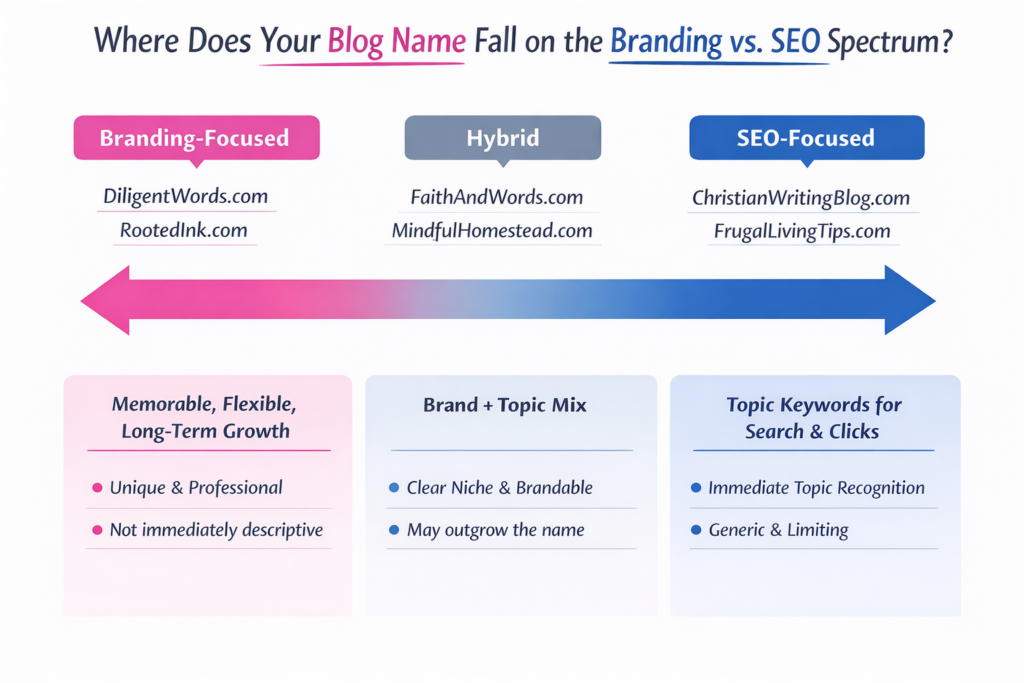
A brand-focused domain is designed to be memorable, flexible, and unique. It tells readers who you are, not just what you write about. These names are easy to say out loud, look professional, and give you room to expand your blog in the future.
Examples:
- DiligentWords.com – works for writing, editing, or teaching.
- RootedInk.com – broad enough to cover multiple content types while still feeling creative.
The benefit: Branding domains age well. Even if your blog topic evolves, your name still makes sense.
The tradeoff: It may not immediately tell a new visitor exactly what your blog is about. You’ll need strong messaging elsewhere—like your tagline, About page, or content titles.
What SEO-Focused Domains Do
An SEO-focused domain leans on keywords to signal your topic. These often describe exactly what the blog covers, which can help with search clarity and click-throughs early on.
Examples:
- FrugalLivingTips.com – instantly communicates the blog’s focus.
- ChristianWritingBlog.com – makes the niche crystal clear.
The benefit: Clear keyword signaling can help attract the right audience quickly and may give a small boost in search visibility.
The tradeoff: These domains can feel generic, limit your growth if you expand topics, and make it harder to stand out in a crowded market.
How to Decide Which Way to Go
Think of it as a range rather than an either/or choice:
- If your goal is long-term brand recognition, prioritize branding.
- If your goal is immediate search clarity, keywords can help, but don’t overstuff your domain.
- A hybrid approach works too: blend a soft keyword into a brandable name (e.g., FaithAndWords.com).
Tip: Search engines care far more about quality content, structure, and consistency than your exact domain name. Prioritize readability, memorability, and brand potential. SEO will follow if your content is strong.
When Keywords in a Domain Name Help—and When They Hurt
If used wisely, keywords can still be useful.
Keywords Help When:
- They naturally fit your brand name
- They describe your core topic without boxing you in
- They don’t make the domain long or awkward
Keywords Hurt When:
- They make the domain clunky or hard to remember
- They lock you into a single content angle
- They sound like every other blog in your niche
If your domain reads like a search query instead of a brand, that’s a red flag.
Semrush has a great Free Keyword Tool for you to use.
Why You Should Avoid Hyphens and Numbers
This is one of the easiest mistakes to avoid when you choose a domain name, and one of the most common. Hyphens and numbers may seem like a quick fix when your preferred domain is taken, but they usually create more problems than they solve.
Your domain name should be easy to remember, type, and share. Hyphens and numbers work against all three.
Avoid Hyphens Because:
They’re hard to say out loud.
If you ever tell someone your blog name in conversation, on a podcast, or during a presentation, hyphens instantly add friction. “It’s myblog dash name dot com” is awkward. And easy to forget.
People forget where they go.
Even when someone hears your domain correctly, they often forget whether there was a hyphen or where it belongs. That confusion sends potential readers to the wrong site, or nowhere at all.
They increase the risk of typos.
Hyphens make domains harder to type quickly, especially on mobile devices. More keystrokes mean more opportunities for errors, which can cost you traffic and credibility.
Avoid Numbers Because:
Are they spelled out or numeric?
When someone hears your domain name, they have to guess: is it “five” or “5”?
They confuse readers.
Numbers interrupt the natural flow of a name and make it harder to remember. A domain should roll off the tongue.
They often look spammy or dated.
Domains with numbers are commonly associated with low-quality sites, temporary projects, or marketing shortcuts. Even if your content is excellent, the name can create an unnecessary trust barrier.
How to Generate Blog Domain Name Ideas
If you’re stuck, try these approaches:
- Combine two relevant concepts (faith + writing, home + simplicity)
- Use metaphors or imagery related to your topic
- Look for words that reflect tone, not just topic
- Start with your name if personal branding makes sense
Write down 10–20 ideas before checking availability. Walk away for a little while, or even a day or two, and come back to the list later. That way, you see it with fresh eyes, and the name you thought you liked yesterday may not be the one you love today.
You can also use AI to generate blog name ideas.
Think About Your Platform Before You Buy
Your domain choice is also connected to how you build your site.
Before you purchase a domain, it’s important to have at least a general idea of which blogging platform you’ll use.
Different platforms handle domain ownership, customization, and control in very different ways.
If you’re still in the early stages, these posts will help you decide:
Why Platform Choice Matters for Your Domain
Domain ownership:
Some platforms offer a free domain as part of their plan, but there’s usually some strings attached. You may not fully own the domain, or it may be tied to the platform in a way that makes moving your site later more complicated.
Customization and branding:
Your platform determines how much control you have over your site’s design, layout, and functionality. If your domain name is brand-focused, you’ll want a platform that allows you to fully customize how that brand is presented.
Long-term flexibility:
Many bloggers outgrow their first platform. If you choose a platform that limits monetization, plugins, or site structure, your domain can feel trapped, even if the name itself is solid.
A Simple Domain Name Checklist
Before you buy, ask yourself:
- Can I say this out loud without explaining it?
- Would I still like this name in five years?
- Does it give me room to grow?
- Is it easy to spell and type?
- Does it sound like a brand—not a keyword list?
If you can say yes to most of these, you’re on the right track.
Final Thoughts
Choosing a domain name doesn’t have to be stressful, but it should be intentional.
You’re not just picking a URL. You’re choosing the foundation your blog will grow on. Aim for clarity, flexibility, and longevity, and you’ll save yourself a rebrand down the road.